
Indian equity markets experienced a volatile session, with the Sensex and Nifty recovering some ground after a significant plunge the previous day. Gains were driven by PSU bank, IT, and metal stocks, but concerns over rising fuel prices and geopolitical tensions limited the recovery.

>It's not easy to predict the market. But there are at least two positive factors to back the PSU banks, explains Tamal Bandyopadhyay.

State-owned enterprises in India are projected to significantly increase their overseas borrowings, potentially exceeding $15 billion in FY27, driven by the Reserve Bank of India's new concessional forex swap facility which offers a 3 per cent funding-cost advantage.

Sectoral funds, focused exclusively on public sector banks (PSBs), have delivered the strongest returns among domestic mutual fund (MF) categories over the past six months. However, active banking funds have significantly lagged because of their heavy tilt towards private lenders.

Opening up the corner office is fine, but will the government be able to attract talent without giving a market-rate salary?, asks Tamal Bandyopadhyay.

The highest number of frauds was reported under the card, Internet, and digital payments categories in FY24 and FY25. 'Advances' accounted for the largest share (85.5 per cent) in FY26.

The banking sector could see better loan growth in the third quarter of financial year 2026 (Q3FY26) with improved net interest margins (NIMs), though the full impact of latest rate cuts will be largely felt in the fourth quarter. There may be lower slippage in unsecured loans and microfinance institutions (MFIs) along with steady recovery trends, which should lower credit cost.

The CBSE revaluation portal experienced a cyber attack, affecting the payment system and leading to unauthorised access for approximately 50 students. The incident caused fee display abnormalities, prompting investigations and system enhancements.

Indian benchmark equity indices, Sensex and Nifty, closed lower due to investor caution over rising bond yields, a weaker rupee, and fresh fuel price hikes, which have revived inflation concerns.

Indian benchmark indices Sensex and Nifty experienced declines due to a sharp rally in crude oil prices, continuous foreign fund outflows, and geopolitical uncertainties. Regulatory developments in the banking sector, particularly the implementation of the Expected Credit Loss (ECL) framework, also contributed to the selling pressure.

Public sector banks have written off loans worth Rs 6.15 lakh crore in the last five and a half years, Parliament was informed on Monday.

PSU bank stocks are witnessing hectic activity these days and are now among the top traded stocks on the bourses.

Does the Union government or the RBI see itself as Krishna beheading Shishupal and what will constitute the 101st or indeed the past many sins for which a Sudarshan Chakra will have to be used? More importantly, what are those sins?

Indian equity markets closed higher, driven by gains in PSU bank, auto, and financial stocks, following the US Supreme Court's decision on tariffs. Sensex climbed 479.95 points to 83,294.66, and Nifty advanced 141.75 points to 25,713.

'Investors should not commit fresh money to these stocks right now, unless they can hold for the next three to four years.'

The Reserve Bank of India (RBI) and the central government have introduced a package of measures, including tax exemptions for FPIs on government securities and a concessional foreign-exchange swap facility, aiming to attract up to $50 billion in foreign capital. This initiative is designed to strengthen India's balance of payments and potentially cover the projected BoP gap for FY27.
Benchmark equity indices Sensex and Nifty extended their gains for the second straight session on Monday, driven by optimism over the India-US trade deal and robust buying in public sector banks, consumer durables, and realty stocks.
The Indian banking sector could be due for a rise in profitability after several quarters of net interest margin (NIM) compression. The Q2FY26 results suggest NIMs have bottomed out.
Stock markets closed higher for the second straight session on Tuesday, driven by gains in bank, IT and capital goods shares.

Analysts say there is still no visibility of earnings improvement.

Despite geopolitical tensions and FII outflows, Indian small and midcap stocks have not only recovered losses but are also outperforming largecap indices, driven by attractive valuations, domestic institutional support, and a rebound in earnings.

Indian equity investors experienced a significant loss of 16.32 lakh crore due to a two-day stock market decline fueled by escalating geopolitical tensions involving the US, Israel, and Iran.
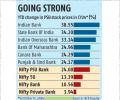
Stock Market News today, PSU banks: The year 2024 was a roller-coaster ride for Indian stock markets, marked by volatility driven by the Lok Sabha elections, Union Budget 2024, a slowdown in corporate earnings, and sticky inflation. Geopolitical tensions - particularly between Israel and Iran in West Asia - along with various stimulus announcements by China and yen carry trade rocked the equity markets throughout the year.
The combined market capitalisation of the 21 listed PSU banks declined by about Rs 76,000 crore to Rs 425,800 crore during the month.

Public sector banks (PSBs) have written off bad loans of about Rs 5.82 lakh crore in the last five financial years, Parliament was informed on Tuesday. During 2024-25, the loan write-off of PSBs was at Rs 91,260 crore, compared to Rs 1.15 lakh crore in the previous fiscal, Minister of State for Finance Pankaj Chaudhary said in a written reply to the Rajya Sabha.

The World Bank and India have concluded negotiations for loans worth $3.2 billion for recapitalising state-run banks and funding for the India Infrastructure Finance Company Ltd, a state-run lender to infrastructure projects.
'The universe of PSU stocks is huge and diverse.' 'Investors should bet on specific sectors and stocks from the basket as most of them may continue to consolidate after years of outperformance.'

Indian markets on Dalal Street rallied sharply as easing tensions in the US-Iran conflict and stable oil prices boosted sentiment. Track Nifty 50 and BSE Sensex performance and key global triggers.

This is the first tranche of capital infusion for the fiscal and more funds would be provided in future depending upon the performance of PSU banks.
Market sentiment is likely to remain cautious as investors position themselves for the upcoming Union Budget and the US Fed's interest rate decision, where expectations are muted.
The overall debt servicing metrics of Indian corporates are weak.
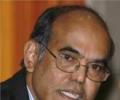
Subbarao also warned of attrition in PSBs, saying, "PSBs will lose talent to the private sector."
A major reshuffle of top executives in 11 PSU banks is on the cards with the chairmen of Allahabad Bank, Corporation Bank, Syndicate Bank, Union Bank of India and Vijaya Bank slated to retire between March-July 2006.

Among the Sensex constituents, Asian Paints, Tech Mahindra, HCL Technologies, Tata Steel, Maruti Suzuki India, Sun Pharmaceuticals, Tata Consultancy Services, ICICI Bank, Bajaj Finance, UltraTech Cement, Mahindra & Mahindra and Tata Motors Passenger Vehicles were the laggards. However, Eternal, Titan, Adani Ports, Bharat Electronics Ltd, State Bank of India, Bajaj Finserv, NTPC and Bharti Airtel were among the gainers.
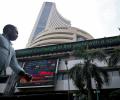
Benchmark stock indices Sensex and Nifty closed on a flat note in a choppy session on Wednesday as gains in PSU banks and auto shares were offset by losses in IT stocks.

A section of the public sector banking employees will go on two-day all-India strike from Wednesday to protest against financial sector reforms and outsourcing of jobs.

'For those in for the long haul, this is a God-given opportunity.' 'Your market is falling despite strong fundamentals, and such a clear roadmap has been announced.'

As of June, the gross NPA of nationalised banks was 3.89 per cent and State Bank Group at 5.50 per cent.

The country's largest public sector lender State Bank of India on Monday fixed its benchmark lending rate at 7.5 per cent following a Reserve Bank directive, a move that will end the practice of sub-prime loan to corporates.

The rally followed the govt's plan to bolster state-owned lenders.
